

Preparing for KCET along with board exams can get difficult when you treat them as two separate preparations. You may spend hours revising your PUC syllabus, then realise you haven’t done enough MCQ practice. Or you may focus heavily on KCET and leave board-style writing and revision for later.
The smarter approach is to connect your preparation. Your board studies help you build the concepts needed for KCET, while MCQs, previous-year questions and timed practice help you apply them quickly.
In this blog, we’ll explain how to plan your study time, prepare the same topics for both exams, adjust your priorities as board exams approach and use the post-board period effectively for KCET.
How Board Exams and KCET Are Different
Board exams focus on how well you can understand, explain and present a topic in writing. You’ll need to write detailed answers, derivations, diagrams, definitions and step-by-step solutions.
KCET focuses on how quickly and accurately you can apply what you’ve learned to multiple-choice questions. It requires strong concept recall, formula application, question-solving speed and regular MCQ practice.
So, while the syllabus and concepts overlap, the way you prepare and answer questions is different.
8 Practical Strategies to Balance KCET and Board Exam Preparation

Preparing for boards and KCET together making your study list feel twice as long? But you don’t need two separate study plans. Your board preparation already covers much of what
you need for KCET so build on it with focused MCQs, revision and timed practice by following the below steps:
1. Study One Topic Twice
When you finish a topic, practise it in both formats while it’s still fresh. Review the concept, write a few important answers and solve numerical problems. Then spend 20–30 minutes on related MCQs.
You’ll reinforce what you’ve learned without starting another study session from scratch.
2. Find Your Weak Spots
Instead of labelling yourself “weak in Physics” or “bad at Maths,” find the topics where you actually lose marks.
Mark each topic as strong, average or weak, then write down the reason:
- Concept gap: You don’t understand it yet.
- Memory gap: You forget formulas, reactions or facts.
- Calculation error: Your method is right, but the answer goes wrong.
- Question gap: You understand the topic but struggle with MCQs.
- Time issue: You know how to solve it but take too long.
Now you have something specific to work on.
3. Keep MCQ Practice Short
You don’t need a long MCQ session every day. A focused 30–45 minutes is enough for regular practice.
Try solving questions soon after studying a topic. On a busy day, cut the number of questions rather than skipping practice completely. Even 15–20 well-reviewed questions can be useful if you understand why you got them wrong.
4. Change Your Focus
Your priorities should move with the exam schedule.
When you have more time, concentrate on completing the syllabus and strengthening difficult topics. As board exams get closer, spend more time on written answers, derivations, diagrams, numericals and previous board papers.
After boards, move towards timed KCET sets, mixed-topic practice and full-length papers.
5. Follow Learn, Write, Solve
Use this simple routine when studying a topic:
Learn: Understand the concept and how it works.
Write: Practise the answers, derivations, diagrams or numerical problems you need to present in your board exam.
Solve: Test your understanding with objective questions.
If you can write an answer but struggle with MCQs, you need more application practice. If you can’t explain the concept clearly, go back to the basics first.
6. Plan Your Week
A weekly plan gives you structure without forcing every hour into a fixed timetable.
Set a few clear targets for the week. For example, decide which topics you’ll complete, when you’ll revise them and when you’ll take a test. Keep a little spare time for college work, assignments and topics that take longer than expected.
And if one day goes badly, adjust the plan. You haven’t lost the whole week.
7. Keep an Error Log
Don’t record only your test scores. Keep track of the mistakes that cost you marks.
Use four simple columns:
Question | Mistake | Correct concept | Next step
You may find that you repeatedly forget a formula, misread questions or make calculation errors. Once you spot the pattern, spend your next study session fixing it.
8. Build Speed Gradually
Accuracy comes before speed. Once you’re comfortable solving a particular type of question, introduce a time limit to it.
Start with a small set of MCQs. If a question takes too long, mark it and move ahead. Return to it later if you have time.
After the set, check three things: How many did I get right? Where did I lose time? Which questions should I have skipped?
That review will help you become faster without turning every practice session into a race.
5 Common Preparation Mistakes to Avoid
You don’t need a complicated study system to prepare well. A few common habits can make your workload feel heavier than it actually is. Watch out for these mistakes:
1. Using Two Separate Plans
Treating boards and KCET as completely separate syllabuses can double your workload. Use your regular syllabus as the base, then add MCQs, timed practice and previous-year questions where needed.
2. Neglecting Board Exams
Don’t focus so heavily on KCET scores that your board preparation suffers. Written answers, derivations, diagrams and numerical problems still need regular practice, especially as board exams get closer.
3. Delaying KCET Practice
Leaving all MCQ practice until after your boards can make the transition harder. Keep a short, regular KCET practice slot so you stay comfortable with objective questions and time limits.
4. Copying Someone’s Timetable
Your friend’s study plan may look perfect, but their strengths, weak areas, college schedule and study pace could be completely different from yours. Build a routine around what you actually need to improve.
5. Counting Only Study Hours
5 hours at a desk doesn’t tell you much about your preparation but tracking chapters completed, questions solved, mistakes corrected and test scores, does. These give you a clearer picture of whether your preparation is moving forward.
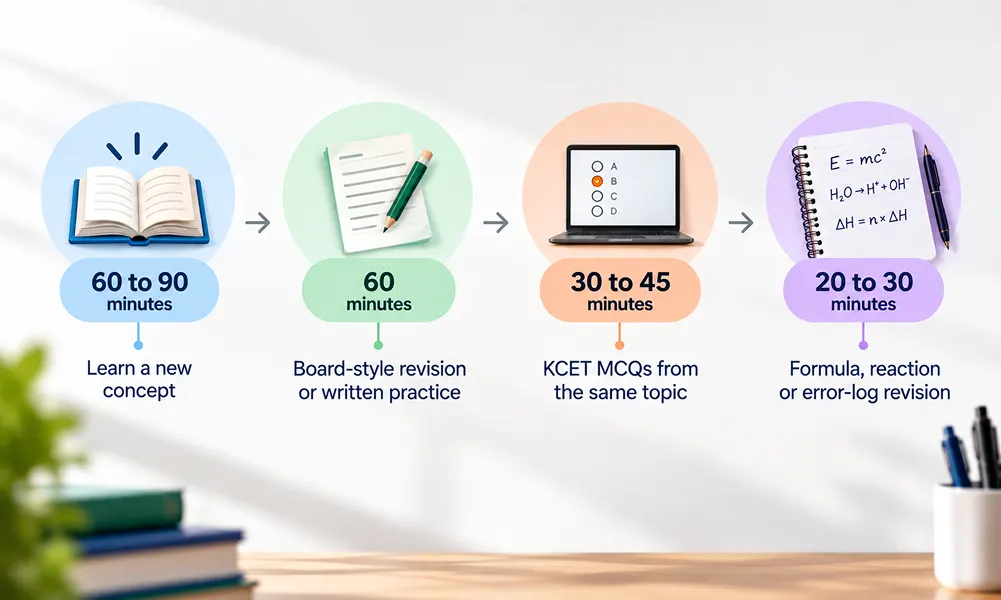
A Sample Daily Study Time Table
You don’t need a 12 hour timetable to prepare well. A simple structure can work better if you can actually follow it every day.
On a regular college day, you could use:
60 to 90 minutes: Learn a new concept
60 minutes: Board-style revision or written practice
30 to 45 minutes: KCET MCQs from the same topic
20 to 30 minutes: Formula, reaction or error-log revision
On a lighter day, add a longer mixed-question or previous-year paper session.
The exact number of hours can change. What matters is that your day includes learning, active practice and revision. And if you miss one session, don’t throw away the whole plan rather adjust the next day and continue.
Conclusion
You don’t have to choose between doing well in your board exams and preparing seriously for KCET. Build your concepts properly, practise presenting answers for boards, and use MCQs and timed tests to improve your speed. Keep checking where you’re losing marks and adjust your study plan instead of simply studying for longer hours.
If you’re looking for structured support while preparing for both exams, Vidya Soudha Integrated PU College brings PU academics and KCET entrance-exam preparation together, helping you stay consistent, get the guidance you need and work towards both goals with confidence. Enrol today!
Frequently Asked Questions
1. Can I start KCET preparation before finishing my board syllabus?
Yes. You need not wait until your board syllabus is complete. Start with the topics you’ve already studied and solve a few KCET MCQs alongside them. This keeps your objective-question practice going without taking time away from your regular studies.