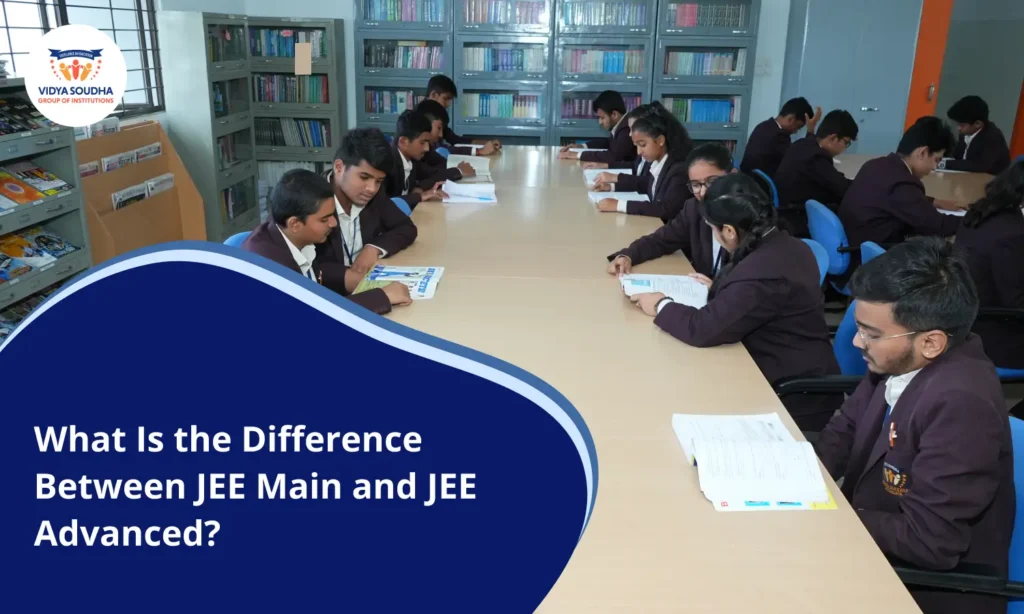
Are you confused about JEE Main and JEE Advanced and don’t know where to start? We know it feels overwhelming when everyone says both are important, but no one clearly explains how they differ or what really matters for your future.
You study hard every day in Class 11 and 12, but without a clear plan, stress builds up, doubts creep in, and even small mistakes start feeling huge and discouraging.
We’re here to help you cut through the confusion. In this blog, we’ll show you what each exam really means, how they fit into your engineering journey, and how you can prepare smartly to stay calm, focused, and confident from the very start.
What Is JEE Main?
| Aspect | Details |
|---|---|
| Who can appear | Students appearing for or who have completed Class 12. |
| Subjects covered | Physics, Chemistry, and Mathematics based on Class 11 and 12 syllabus. |
| Exam pattern | Objective and numerical-based questions. |
| Attempts and flexibility | Conducted multiple times a year. |
| Focus area | Basics, speed, accuracy, and consistency. |
Once students understand JEE Main properly, it becomes clear that this exam builds the base. From here, the journey naturally moves to the next stage.

What Is JEE Advanced?
JEE Advanced is the second stage of the JEE process and is meant only for students aiming to enter the IITs. Not everyone who writes JEE Main can appear for this exam. Only students with top ranks in JEE Main qualify.
This exam looks very different from JEE Main in the way it tests students.
| Aspect | Details |
|---|---|
| Purpose of the exam | Admission into IITs only. |
| Eligibility criteria | Top rankers from JEE Main with limited attempts. |
| Exam structure | Two compulsory papers |
| Type of questions | Analytical and concept-based. |
| Skill tested | Deep understanding and logical thinking. |
Key Differences Between JEE Main and JEE Advanced
| Aspect | JEE Main | JEE Advanced |
|---|---|---|
| Purpose | Admission to many engineering colleges and qualification for Advanced | Admission into IITs |
| Conducting Body | National Testing Agency | IITs on rotation |
| Eligibility | Class 12 students | Top rankers from JEE Main |
| Attempts | Multiple attempts allowed | Limited attempts |
| Exam Pattern | Single paper for B.Tech | Two compulsory papers |
| Question Style | Objective and numerical | Analytical and conceptual |
| Focus Area | Speed and accuracy | Depth of understanding |

Study Tips for JEE Main and JEE Advanced
- Get your basics right
Start with NCERT and take your time with each chapter. When you understand why a formula works, you’ll find it easier to solve both direct and tricky questions later. - Practice with intention
Solve questions every day, but don’t rush through them. When you make a mistake, pause and figure out what went wrong. This helps you avoid repeating the same errors in exams. - Improve speed gradually
For JEE Main, speed matters. Use a timer while practising so you learn when to move ahead and when to skip. Over time, you’ll get better at managing pressure. - Think deeper for Advanced
For JEE Advanced, slow down and focus on the logic behind each step. If a problem feels tough, break it into smaller parts instead of forcing an answer. - Revise in small cycles
Don’t wait till the end to revise. Short weekly revisions help you remember concepts longer and reduce last-minute stress. - Review mock tests honestly
Treat mock tests as learning tools. Look at where you lost marks and ask yourself why. Fixing these gaps early makes a real difference
When you prepare this way, JEE Main and JEE Advanced stop feeling like two different battles and start feeling manageable together.
Why Integrated Preparation Matters
Most students aren’t tired of studying, they’re tired of running between school, coaching, and extra classes, which leaves little time to revise or rest. When learning is scattered, even sincere effort starts feeling overwhelming.
Integrated preparation simplifies this by teaching the PU syllabus and JEE coaching together, which helps concepts connect faster, reduces repetition, and saves time that would otherwise be lost in travel. With a balanced routine, students stay calmer, revise better, and perform more consistently.
That’s why an integrated PU college like Vidya Soudha works well. With academics and JEE prep under one roof, students gain structure, focus, and the mental space needed to do their best.
Conclusion
JEE Main and JEE Advanced are part of the same journey, not separate struggles. Each exam tests different skills, and knowing this early helps you prepare with focus instead of stress. When your concepts are clear and practice is steady, learning feels manageable, and you stay confident through both boards and entrance exams.
If you want a smarter, calmer approach, Vidya Soudha PU College is the place to be. Our integrated model combines PU syllabus and JEE coaching in one place, saving your time, reducing pressure, and giving you the guidance to stay ahead. Enrol now for simpler, focused, and far more effective preparation.
Frequently Asked Questions
1. Can I prepare for JEE Main and JEE Advanced together?
Absolutely! You don’t have to treat them as separate exams. If you focus on your basics, practise every day, and balance speed with understanding, your JEE Main preparation will naturally set you up for Advanced as well. It actually makes things much easier.
2. How many times can I attempt JEE Main and JEE Advanced?
You can appear for JEE Main three times a year, so you get chances to improve your score. For JEE Advanced, you can attempt it twice in two consecutive years. This makes your Main performance really important.