
Many CA aspirants spend weeks choosing books and creating study plans but overlook the CA exam pattern. Without understanding the paper structure, marking scheme, and passing criteria, it’s easy to prepare without a clear direction.
That often becomes a problem during revision, when students realise they haven’t studied according to the paper pattern or subject weightage. Starting with the right information can help you plan your preparation more effectively.
This guide explains the complete CA exam pattern for 2026, including the subject-wise breakdown, marking scheme, passing criteria, and the latest ICAI updates for the Foundation, Intermediate, and Final levels.
CA Exam Pattern 2026 at a Glance
Before jumping into each level, it helps to zoom out. The CA course runs across three stages, and each one builds on the last.
Students planning to pursue CA after Class 12 often start their journey at a PU Colleges Bangalore that offers strong commerce fundamentals.
Here’s a quick snapshot:
| Level | Papers | Total Marks | Duration | Mode | Question Type |
|---|---|---|---|---|---|
| Foundation | 4 | 400 | 3 Hours | Offline | Descriptive & Objective |
| Intermediate | 6 | 600 | 3 Hours | Offline | Descriptive with Objective |
| Final | 6 | 600 | 3 Hours | Offline | Descriptive & Case-Based |
CA Foundation Exam Pattern & Subject-Wise Marking Scheme
| Particular | Details |
|---|---|
| Papers | 4 |
| Total Marks | 400 |
| Duration | 3 Hours each |
| Mode | Offline |
| Medium | English or Hindi |
| Question Type | Descriptive and Objective |
| Negative Marking | Applicable only in objective papers |
CA Foundation Subjects: What You'll Study
The CA Foundation covers four subjects that build the fundamentals needed for the next level. Each paper focuses on a different skill, making it important to understand the syllabus before you begin your preparation.
- Accounting: Accounting principles, journal entries, ledger accounts, trial balance, and financial statements.
- Business Laws: Business regulations, legal principles, and commercial laws.
- Quantitative Aptitude: Business mathematics, logical reasoning, and statistics.
- Business Economics: Basic economic concepts and business economics.
The CA foundation exam syllabus covers a broad range of concepts, so regular revision and practice are key to completing it confidently.
Still weighing your options? Our guide on Career Options After 12 Commerce covers paths beyond CA as well.
CA Intermediate Subjects

The Intermediate level builds on the concepts learned in the Foundation course and introduces subjects that require analytical thinking and practical application.
- Advanced Accounting: Advanced accounting standards, company accounts, and financial reporting concepts.
- Corporate & Other Laws: Corporate laws, business regulations, and legal provisions relevant to businesses.
- Taxation: Direct and indirect taxation, including income tax and GST fundamentals.
- Cost & Management Accounting: Costing techniques, budgeting, decision-making, and performance management.
- Auditing & Ethics: Auditing principles, professional ethics, and assurance practices.
- Financial Management & Strategic Management: Financial planning, investment decisions, risk management, and business strategy.
CA Final Subjects
The Final level focuses on advanced concepts and practical application to prepare you for a professional career as a Chartered Accountant.
- Financial Reporting: Advanced accounting standards, corporate financial reporting, and financial statement analysis.
- Advanced Financial Management: Capital budgeting, valuation, treasury management, and financial decision-making.
- Advanced Auditing, Assurance & Professional Ethics: Advanced auditing practices, assurance engagements, and professional ethics.
- Direct Tax Laws & International Taxation: Advanced direct tax provisions, international taxation, and tax planning.
- Indirect Tax Laws: GST, customs laws, and other indirect tax regulations.
- Integrated Business Solutions: Case study-based paper that tests your ability to apply accounting, taxation, auditing, finance, and law concepts in real business scenarios.
Now that we know the subjects, let us understand the marking scheme to prepare well.
CA Foundation Subject-Wise Marking Scheme
| Paper | Subject | Marks | Pattern |
|---|---|---|---|
| Paper 1 | Accounting | 100 | Descriptive |
| Paper 2 | Business Laws | 100 | Descriptive |
| Paper 3 | Quantitative Aptitude | 100 | Objective |
| Paper 4 | Business Economics | 100 | Objective |
Each paper is worth 100 marks, making the total 400 marks. The descriptive papers assess conceptual understanding, while the objective papers test accuracy and analytical skills.
Once you complete the Foundation level, the Intermediate and Final exams place greater emphasis on applying concepts in practical and professional scenarios.
CA Intermediate & Final Exam Pattern
CA Intermediate Exam Pattern
The Intermediate level strengthens your understanding of accounting, taxation, auditing, and financial management while preparing you for more application-based questions.
Groups: 2 | Papers: 6 | Total Marks: 600 | Duration: 3 Hours | Mode: Offline
| Paper | Subject |
|---|---|
| Paper 1 | Advanced Accounting |
| Paper 2 | Corporate & Other Laws |
| Paper 3 | Taxation |
| Paper 4 | Cost & Management Accounting |
| Paper 5 | Auditing & Ethics |
| Paper 6 | Financial Management & Strategic Management |
CA Final Exam Pattern
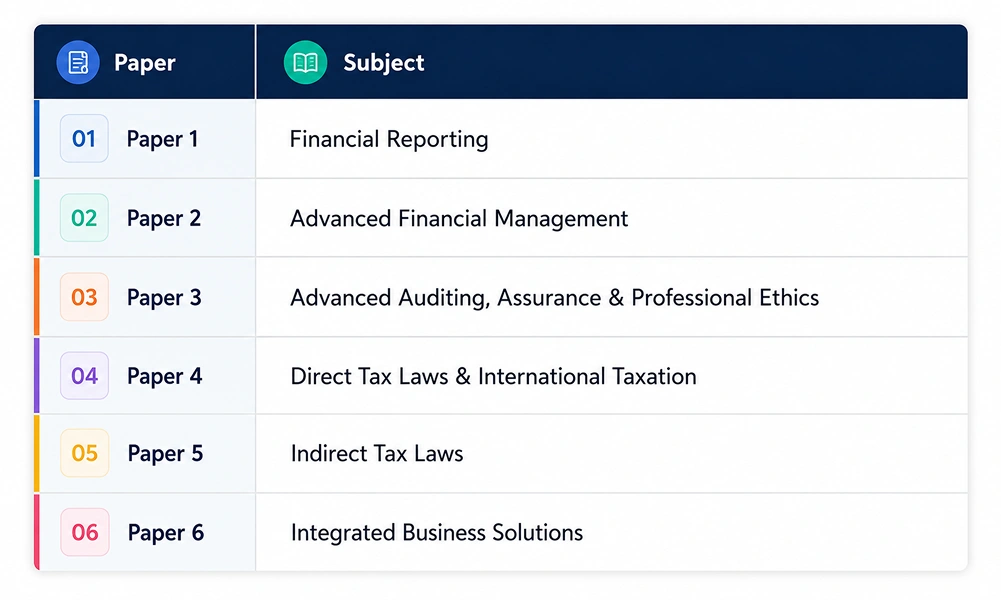
The Final level assesses your ability to apply technical knowledge in professional and case-based scenarios. It is the last step before qualifying as a Chartered Accountant.
Groups: 2 | Papers: 6 | Total Marks: 600 | Duration: 3 Hours | Mode: Offline
| Paper | Subject |
|---|---|
| Paper 1 | Financial Reporting |
| Paper 2 | Advanced Financial Management |
| Paper 3 | Advanced Auditing, Assurance & Professional Ethics |
| Paper 4 | Direct Tax Laws & International Taxation |
| Paper 5 | Indirect Tax Laws |
| Paper 6 | Integrated Business Solutions |
CA Passing Criteria & Marking Scheme
To pass the CA exam, you must meet both the minimum paper-wise marks and the overall aggregate requirement. Missing either one means you won’t qualify for that group.
- Minimum 40% in each paper
- Minimum 50% aggregate in each group
- Both conditions must be met to pass
Scoring high in some papers cannot compensate for scoring below 40% in another. ICAI also offers exemptions in certain cases, subject to its latest guidelines.
With the passing criteria covered, let’s look at the latest changes to the ICAI exam pattern.
Latest ICAI CA Exam Pattern Changes for 2026
ICAI has introduced several updates to make the CA course more practical and industry-focused. Here are the key icai ca exam pattern changes for 2026:
- Intermediate and Final papers have been reduced from 8 to 6.
- Greater emphasis on application-based and case-study questions.
- Syllabus updated to align with current industry requirements.
- Integrated Business Solutions introduced as a new paper in the Final level.
- Increased focus on analytical thinking and professional judgement.
Another key update is the exam schedule. The CA Foundation and Intermediate exams are held three times a year, while the CA Final exam is conducted twice a year, giving students greater flexibility to plan their preparation.
7 Preparation Tips Based on the Latest CA Exam Pattern
Understanding the CA exam pattern gives you the right starting point. The next step is following a preparation strategy that keeps your studies organised and helps you perform well in every paper.
- Know the Syllabus: Before creating a study plan, make sure you’re following the latest ICAI syllabus. This helps you avoid spending time on topics that are no longer part of the exam.
- Study Consistently: Set a realistic timetable and give every paper enough attention. Consistent daily study is much more effective than trying to cover everything at the last minute.
- Solve PYQs: Practise previous years’ question papers regularly. They’ll help you understand the exam pattern, identify important topics, and build confidence.
- Take Mocks: Attempt ICAI mock tests in exam-like conditions. They improve your speed, time management, and help you get comfortable with the paper format.
- Revise Regularly: Go back to completed topics every week instead of waiting until the final revision. Frequent revision makes concepts easier to remember.
- Understand Concepts: Focus on learning why a concept works instead of memorising answers. This becomes especially important in the Intermediate and Final levels.
- Track Updates: Keep checking ICAI notifications for any changes to the syllabus, exam pattern, or exam schedule so you’re always preparing with the latest information.
Preparing consistently with the right strategy is often more effective than studying for long hours just before the exam.
Conclusion
Your preparation becomes much more effective when you know exactly what the CA exam expects. A clear understanding of the paper pattern, subject-wise marking, passing criteria, and the latest ICAI updates helps you plan your studies better, manage your time wisely, and prepare with confidence for every level.
If you want to become a Chartered Accountant, Vidya Soudha PU College Bangalore offers the right start with integrated board and CA Foundation coaching, experienced faculty, and structured academic support.