Learning English vocabulary can sometimes feel frustrating. You learn new words today, forget them tomorrow, and then struggle to use them while speaking. If you’re a student or someone trying to improve English as a second language, this happens more often than you think.
As an English speaking coach, one thing I often notice is that learners try memorizing large vocabulary lists without understanding how words connect to each other. Learning easy opposite words in English helps solve that problem because every word automatically teaches another word too.
In this blog, you’ll learn simple opposite words, understand how to remember them better, and discover practical ways to use them while speaking English confidently.
What Are Opposite Words in English?
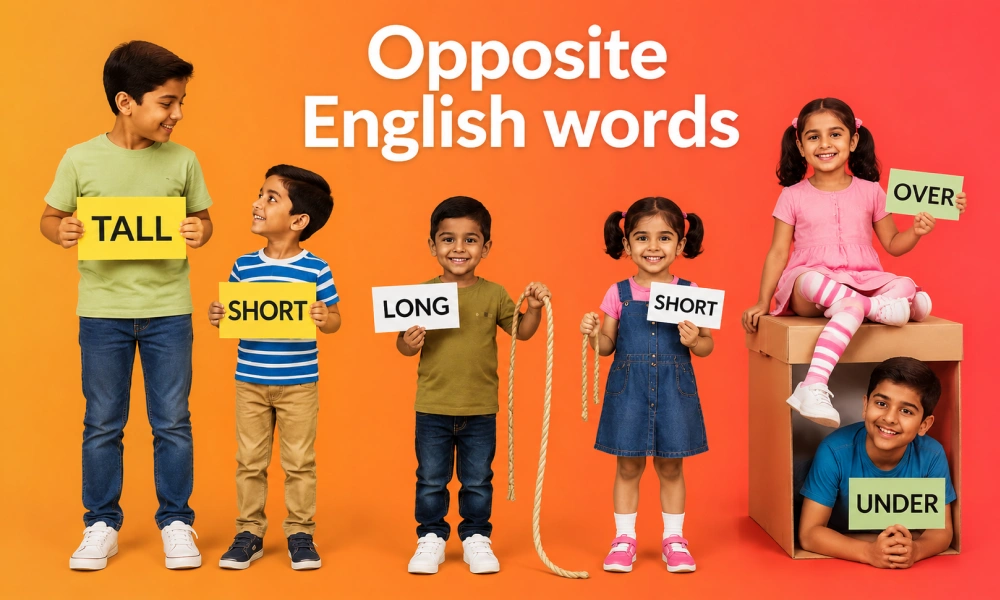
Opposite words are words with completely different meanings. These words are also called antonyms and help learners understand vocabulary more easily through comparison.
Examples:
- Big → Small
- Hot → Cold
- Happy → Sad
- Open → Close
- Fast → Slow
Think about everyday conversations. You already hear opposite words regularly without noticing.
Why Opposite Words Help You Learn English Faster
1. Learn Two Words Together
2. Speak More Confidently
3. Understand English More Easily
4. Remember Words Better
5. Think in English Naturally
As you build word connections, you rely less on translation and start understanding English more naturally.
Once you understand why opposite words matter, learning them becomes much easier.
Easy Opposite Words in English Every Learner Should Know
For learners starting their English journey, focusing on practical vocabulary first usually makes learning easier. Starting with simple, everyday words builds confidence and reduces confusion later.
Start with words you already hear regularly.
| Word | Opposite Word |
|---|---|
| Big | Small |
| Hot | Cold |
| Fast | Slow |
| Happy | Sad |
| Good | Bad |
| Full | Empty |
| Open | Close |
| Strong | Weak |
| Long | Short |
| Easy | Difficult |
| Clean | Dirty |
| Old | Young |
| Rich | Poor |
| High | Low |
| Early | Late |
50 Common Opposite Words List in English
- Accept → Reject
- Arrive → Leave
- Begin → End
- Borrow → Lend
- Buy → Sell
- Big → Small
- Clean → Dirty
- Cheap → Expensive
- Deep → Shallow
- Empty → Full
- Enter → Exit
- Early → Late
- Far → Near
- Fast → Slow
- Friend → Enemy
- Give → Take
- Good → Bad
- Hard → Easy
- Healthy → Sick
- High → Low
- Hot → Cold
- Increase → Decrease
- Kind → Cruel
- Laugh → Cry
- Light → Dark
- Long → Short
- Lose → Win
- Many → Few
- Modern → Ancient
- New → Old
- Noisy → Quiet
- Open → Close
- Positive → Negative
- Rich → Poor
- Right → Wrong
- Rough → Smooth
- Safe → Dangerous
- Same → Different
- Sharp → Blunt
- Strong → Weak
- Sweet → Sour
- Tall → Short
- Thick → Thin
- True → False
- Warm → Cool
- Wet → Dry
- Young → Old
- Wide → Narrow
- Up → Down
- Visible → Invisible
Learn Opposite Words Through Real Life Situations
Opposite Words for Feelings
Happy → Sad
Example: She was happy after the exam results, but felt sad when her friend moved away.
Calm → Angry
Example: He stayed calm during the discussion but became angry after hearing the news.
Excited → Bored
Example: I felt excited before the trip but got bored during the long journey.
Friendly → Unfriendly
Example: The new student seemed friendly, while the shopkeeper was quite unfriendly.
Love → Hate
Example: Some students love mathematics, while others hate it.
Opposite Words Used in School
- Early → Late
Early: We reached school early to prepare for the presentation.
Late: She arrived late because of traffic.
- Correct → Wrong
Correct: Your answer is correct.
Wrong: I chose the wrong option by mistake.
- Easy → Difficult
Easy: The first exercise was easy to complete.
Difficult: The last question was difficult for many students.
- Pass → Fail
Pass: He studied regularly and managed to pass the exam.
Fail: Students may fail if they do not prepare properly.
- Start → Finish
Start: Let us start today’s activity now.
Finish: We finished the assignment before lunch.
Opposite Words Used at Home
- Open → Close
Open: Please open the window for some fresh air.
Close: Remember to close the door before leaving.
- Clean → Dirty
Clean: The kitchen looks clean now.
Dirty: The floor became dirty after the rain.
- Full → Empty
Full: My water bottle is full.
Empty: The glass became empty quickly.
- Wet → Dry
Wet: The clothes are still wet after washing.
Dry: The clothes became dry in the sun.
- Light → Dark
Light: The room feels light during the day.
Dark: The room becomes dark at night.
Opposite Words English Learners Commonly Confuse
- Borrow → Lend
Borrow: means receiving something temporarily from someone.
Example: I borrowed a calculator from my classmate.
Lend: means allowing someone else to use something temporarily.
Example: Can you lend me your notes for today?
- Bring → Take
Bring: means moving something toward a person or place.
Example: Please bring your assignment tomorrow.
Take: means carrying something away from a person or place.
Example: Take your lunch box home.
- Buy → Sell
Buy: means paying money to get something.
Example: She bought a new English workbook.
Sell: means exchanging something for money.
Example: They sell snacks outside the school gate.
- Arrive → Leave
Arrive: means reaching a destination.
Example: We arrived at school before assembly.
Leave: means going away from a place.
Example: He left immediately after class.
- Remember → Forget
Remember: means keeping information in your mind.
Example: Remember to bring your ID card.
Forget: means failing to recall something.
Example: I forgot my homework again.
- Push → Pull
Push: means moving something away using force.
Example: Push the chair under the table.
Pull: means moving something closer to you.
Example: Pull the drawer slowly.
- Accept → Reject
Accept: means agreeing to receive something.
Example: She accepted the competition invitation.
Reject: means refusing something.
Example: The proposal was rejected.
- Include → Exclude
Include: means making something part of a group.
Example: Please include your name on the worksheet.
Exclude: means leaving something out.
Example: Do not exclude important details.
- Increase → Decrease
Increase: means becoming larger or higher.
Example: Practice helps increase vocabulary.
Decrease: means becoming smaller or lower.
Example: Regular revision decreases mistakes.
- Expand → Reduce
Expand: means making something larger or wider.
Example: Reading helps expand vocabulary.
Reduce: means making something smaller or less.
Example: Speaking daily can reduce hesitation.
How to Remember Opposite Words Faster
1. Learn Words in Pairs
Learning opposite words together helps your brain create stronger connections between meanings. Instead of learning single words separately, practice them as pairs such as:
- Happy → Sad
- Hot → Cold
- Big → Small
This makes vocabulary easier to recall later.
2. Create Visual Connections
Connecting words with images makes them easier to remember because your brain processes visuals faster than plain text.
For example:
- Imagine hot tea for hot
- Imagine ice cream for cold
Simple mental pictures can improve memory significantly.
3. Use Personal Examples
Vocabulary becomes easier to remember when you connect it to your own experiences. Try creating simple sentences using words from your daily life.
For example:
- My room is clean.
- My study table is dirty.
Personal connections help words stay longer in memory.
4. Practice Small Amounts Every Day
Avoid trying to learn too many words at once. Practicing for 10 to 15 minutes daily is usually more effective than studying large lists occasionally.
Small and regular practice creates better long term retention.
5. Speak Words Out Loud Regularly
Reading silently is helpful, but saying words aloud improves memory and pronunciation together.
Try to:
- Read opposite words aloud
- Use them while speaking
- Repeat them in simple sentences
The more frequently you use words, the easier they become to remember.
Conclusion
Learning easy opposite words in English helps improve vocabulary, communication skills, and everyday English usage. Regular practice, simple examples, and using words in real conversations can gradually build stronger language skills and confidence.
To build stronger communication skills and improve English through practical learning, consider enrolling at Vidya Soudha Group of Institutions and learn in an environment focused on growth and confidence building.